

How Often Should You Trim Your Trees
Healthy trees and shrubs grow every year, with most new growth occurring during Michigan’s spring and summer growing season. In southern Michigan communities like West Bloomfield, trees often begin showing active growth in early to mid-April, while in northern areas like Traverse City, the growing season typically begins around mid-April to early May. Because every species has its own natural growth pattern, proper pruning should work with the plant—not against it—to maintain healthy structure and natural form over time.
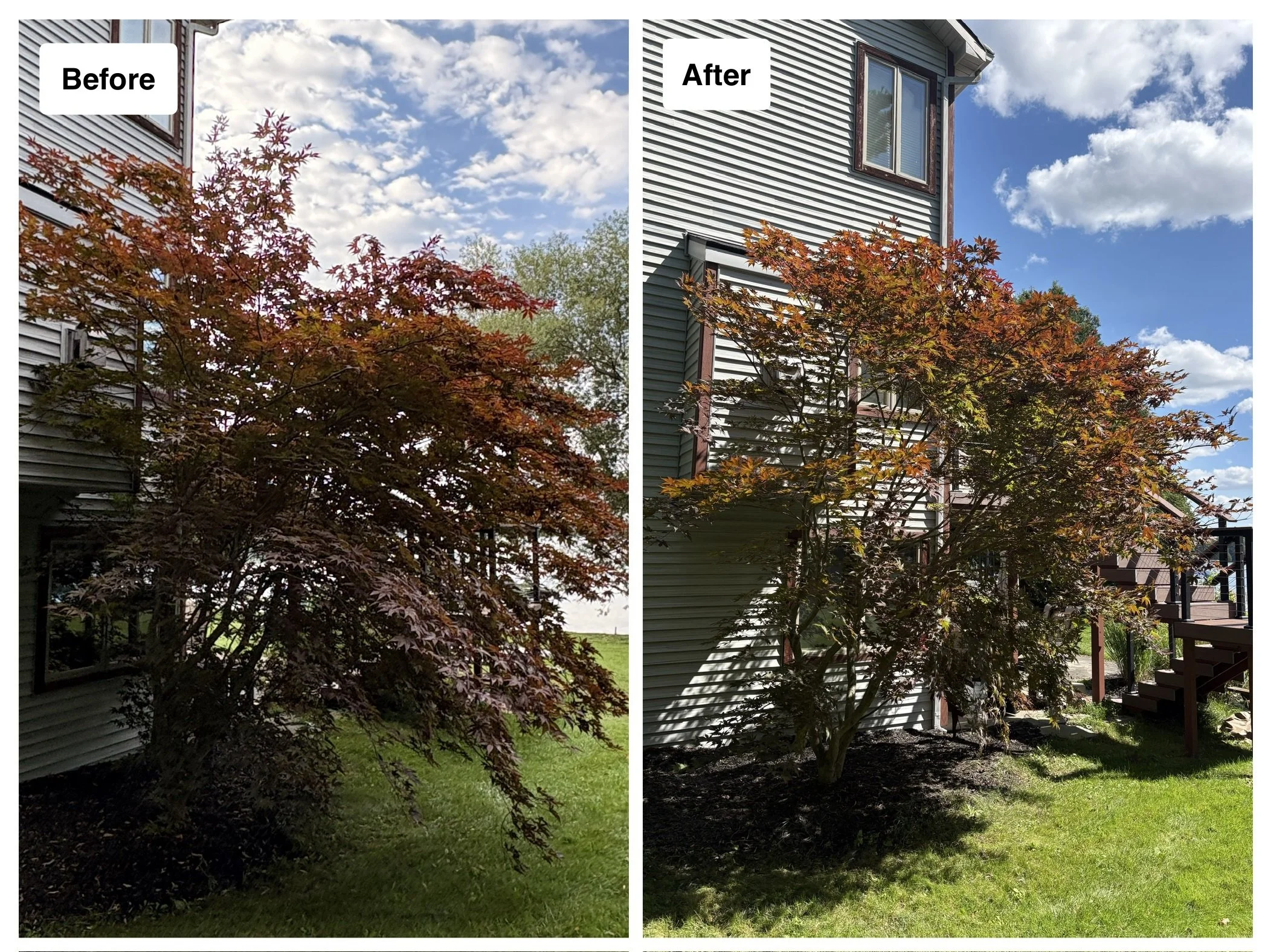
This Japanese Maple had never been pruned and had become significantly overgrown, with branches beginning to encroach on the homeowner’s house and deck. For this customer in Traverse City, Michigan, we carefully reduced the tree’s overall size while improving its structure, restoring clearance, and maintaining its natural shape.
Why Should I Trim My Trees?
Manage Overgrown Trees
Trees can eventually outgrow their space, interfering with roofs, buildings, power lines, driveways, or other plants. Selective pruning can reduce problematic growth while maintaining the tree’s natural shape.Improve Tree Structure
Proper pruning can correct structural problems such as competing leaders, weak branch attachments, and poorly positioned branches. Addressing these issues early can help a tree develop a stronger, more stable structure as it grows.Remove Dead, Damaged, or Diseased Branches
Dead and damaged branches can become hazards, especially during high winds and heavy snow. Removing problem branches also allows the tree to put its resources toward healthy growth.Reduce the Risk of Falling Branches
Weak, dead, or damaged branches are more likely to fail. Removing them can reduce the risk of branches falling onto homes, vehicles, people, or other property.Improve Clearance
Proper trimming can keep branches away from buildings, roofs, walkways, driveways, and other areas where clearance is needed.Maintain a Natural, Attractive Shape
Thoughtful pruning works with a tree’s natural growth pattern rather than simply cutting it back. Removing selected branches can improve the tree’s appearance while preserving its natural form.
Factors That Determine How Often a Tree Should Be Pruned
Tree Species
Different tree species have different growth rates, branching habits, and natural forms. Fast-growing trees may require more frequent pruning to manage new growth, while slower-growing trees can often go longer between pruning visits. The ideal pruning schedule also varies by species because some trees have specific seasonal pruning requirements or are more susceptible to certain diseases.
Age of the Tree
The age of a tree can also influence how often it should be pruned. Young trees often benefit from more frequent structural pruning to help establish strong branch spacing and correct potential problems while they are still small. As trees mature, pruning generally becomes more focused on removing dead or damaged branches, maintaining clearance, and addressing structural or safety concerns.
Tree Location
Where a tree grows can have a major impact on how often it needs to be pruned. A tree growing in an open area with plenty of space may require little maintenance, while a tree growing close to a house, driveway, road, sidewalk, or utility line may need more frequent pruning to maintain proper clearance. Trees in developed areas often require more attention simply because their natural growth can eventually interfere with surrounding structures or property.
Signs Your Tree May Need Pruning
Not sure if your tree is due for a trim? Trees often show clear signs when pruning is needed. Regularly inspecting your trees can help you identify problems early and prevent small issues from becoming larger, more expensive ones.
Branches Growing Too Close to Structures
Trees growing near homes, roofs, driveways, sidewalks, or other structures may need periodic pruning to maintain adequate clearance. Addressing these branches before they become a problem can help prevent property damage and keep the tree properly positioned within its space.Excessive or Overgrown Growth
If a tree has become noticeably overgrown, developed long or poorly positioned branches, or is blocking views or sunlight, pruning may help restore its shape and improve its overall structure.Dead or Broken Branches
Dead, dying, or broken branches should be removed before they become a safety hazard. These branches can fall unexpectedly, especially during high winds or heavy snow, and can also provide entry points for insects and disease.Branches Rubbing or Crossing
Branches that rub against each other can damage the bark and create wounds where insects and disease can enter. Crossing or poorly positioned branches may also develop into structural problems as the tree grows.
How Gordon’s Tree & Shrub Approaches Tree Pruning
At Gordon’s Tree & Shrub, we approach tree pruning with the long-term health, structure, and appearance of the tree in mind. Rather than simply cutting back branches, we evaluate the tree’s species, age, location, growth pattern, and overall condition to determine what type of pruning is appropriate. Our goal is to make thoughtful cuts that improve the tree while maintaining its natural shape and structure.
Our tree pruning services focus on removing dead, damaged, crossing, or poorly positioned branches while addressing clearance and structural concerns when needed. We use natural pruning techniques designed to preserve the tree’s natural form rather than forcing it into an unnatural shape. When size reduction or canopy thinning is necessary, we carefully select branches and make appropriate cuts to minimize stress and maintain a balanced canopy.
Whether you need structural pruning for a young tree, deadwood removal from a mature tree, or maintenance pruning around your home, Gordon’s Tree & Shrub can help determine the appropriate approach. We believe good tree pruning is about more than making a tree look neat—it is about maintaining healthy, structurally sound trees that can thrive for years to come.
